
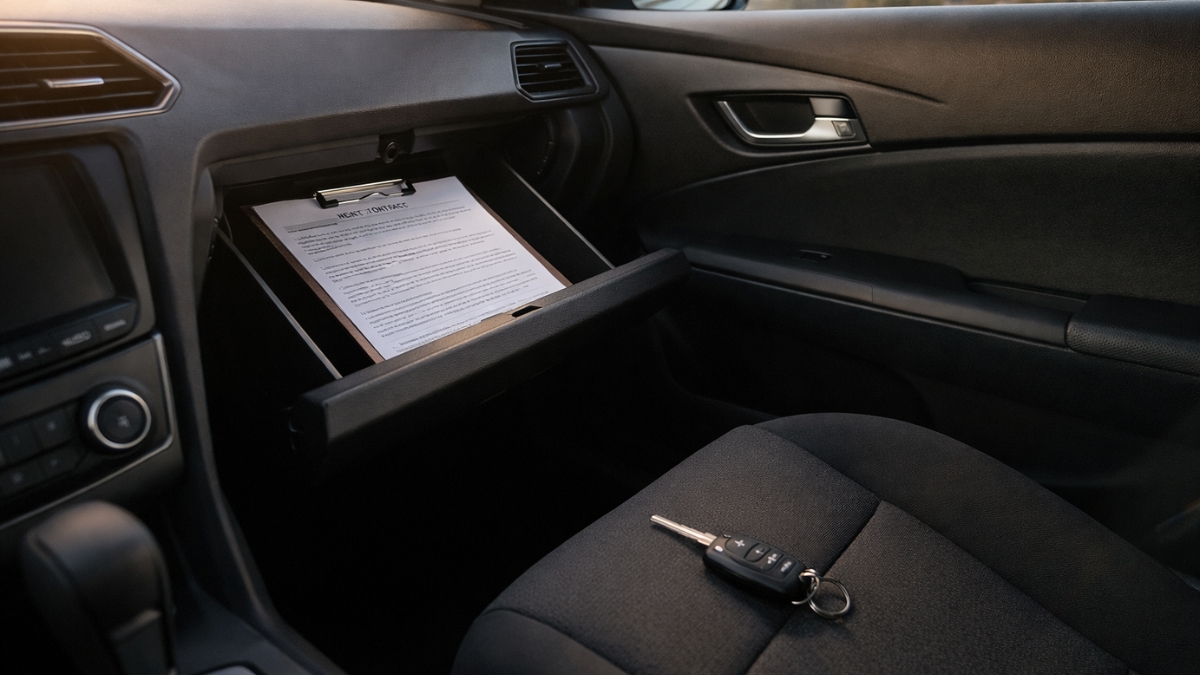
Moroccan rental contracts are usually short, but the important parts are hidden in a few lines that decide what you pay later: deposits, damage rules, fuel charges, insurance limits, and return inspection timing.
If you only do one thing before signing, do this: scan these 12 lines and make sure they match what you were promised (by message, phone, or website). If anything feels unclear, ask for the line to be rewritten or confirmed in writing before you drive away.
Table of Contents
- Start with the “who / what / when” basics
- The 12 lines tourists must check
- The 2-minute signing routine that prevents disputes
- Quick FAQ
1) Start with the “who / what / when” basics
Before the tricky stuff, confirm the contract matches reality:
- Your name + passport number (or ID) and driver license details
- Vehicle plate number and category (make sure it matches the car in front of you)
- Pickup date/time and return date/time (this affects late fees)
- Pickup location and return location (wrong drop-off can trigger extra charges)
In Morocco, timing matters more than people expect, especially if you’re returning at the airport or during busy city traffic.
2) The 12 lines tourists must check
Think of these as the “money lines.” If you read only these, you’ll avoid most surprises.
Line 1: Total price + what’s included
Look for: daily rate, number of days, taxes, and any extras.
Check: Does it clearly include what you were promised (airport delivery, second driver, child seat, etc.)? If it’s not written, assume it’s not included.
Tip: If an add-on was “free,” it should still appear as a zero-cost item.
Line 2: Deposit / pre-authorization amount and method
This is one of the biggest surprise areas. The contract should state:
- deposit amount (or pre-authorization hold)
- which card is used
- when it’s released
Check: The number and the timing. If the contract doesn’t say when the hold is released, ask them to add a note.
A helpful consumer-rights reference on common deposit and damage disputes in car hire is the ECC-Net car rental guidance here: https://www.eccnet.eu/consumer-rights/what-are-my-consumer-rights/travel-and-passenger-rights/road-travel-rights/car
Line 3: Fuel policy (Full-to-Full vs other)
Fuel is where “small print” becomes real money. Look for:
- Full-to-Full (you get it full, return it full)
- Same-to-Same (same fuel level)
- Prepaid / Full-to-Empty (often worst value)
Check: The policy name and whether refueling fees are listed. If it’s not Full-to-Full, ask how they calculate fuel + service fee.
Line 4: Mileage / kilometer limits
The contract must show either:
- Unlimited kilometers, or
- a daily/total limit + cost per extra kilometer
Check: If you plan day trips (Taghazout, Paradise Valley, Essaouira from Marrakech, etc.), limited mileage can quietly become expensive.
Line 5: Insurance type (CDW/LDW/TP) and what it actually covers
Contracts often list abbreviations like:
- TP (third-party)
- CDW/LDW (damage waiver terms)
- sometimes “full insurance” wording (which can be vague)
Check: What’s included by default and what’s optional. If someone sold you “full cover,” make sure the contract shows it as a line item with a clear benefit description.
Line 6: Excess / deductible (the amount you still pay)
This is the number tourists miss most. Even with CDW, there’s often an excess you’re responsible for.
Check: The exact excess amount and whether it changes by car category. If it’s high, ask what upgrade reduces it (and get the new excess in writing).
Line 7: Exclusions (where insurance doesn’t apply)
Even good coverage usually excludes certain damage types, commonly:
- tires and wheels
- glass / windshield
- underbody damage
- roof damage
- lost keys
- clutch damage (often tied to misuse)
Check: These exclusions are usually listed in one paragraph, read it. This paragraph is often the difference between “covered” and “you pay.”
Line 8: Damage reporting + inspection rules
Look for how damage is handled:
- inspection at pickup
- inspection at return
- how claims are made
- whether you get time to dispute
Check: That you can note existing damage at pickup and that you’ll get a fair chance to respond to any damage claim.
For a clear example of what good practice looks like around inspection and disputes, the UK CMA has published practical consumer guidance about transparency and the ability to dispute damage charges: https://competitionandmarkets.blog.gov.uk/2015/10/08/putting-car-rental-customers-in-the-driving-seat/
Line 9: Driver rules (additional driver, age limits, license requirements)
Confirm:
- who is allowed to drive
- cost for additional driver (if any)
- minimum age / license holding period
Check: If a friend or spouse might drive, make sure they are added to the contract, otherwise you risk losing coverage.
Line 10: Territory rules (where you can drive)
Some contracts restrict:
- crossing borders
- driving on unpaved roads
- driving in certain regions
Check: If you plan mountain routes, rural roads, or long road trips, confirm you’re allowed and that insurance remains valid.
Line 11: Fines, tolls, and admin fees
Morocco has toll highways (péage). Contracts often include:
- who pays tolls
- how fines are handled
- an administration fee for processing
Check: If there’s an admin fee, know the amount. It’s not always huge, but it’s good to expect it.
Line 12: Late return policy (grace period + hourly/day charges)
This is where a “cheap day” can become expensive.
Check:
- Is there a grace period (30–60 minutes)?
- After that, do they charge hourly or a full extra day?
If your flight is early or late, make sure your return time matches real travel time.
3) The 2-minute signing routine that prevents disputes
Do this every time, especially at airports:
- Photograph the contract lines 2, 3, 4, 6, 8, and 12 (deposit, fuel, mileage, excess, inspection rules, late policy).
- Walkaround video (30 seconds): front, sides, wheels, windshield, roof line, rear bumper.
- Take a dashboard photo showing fuel level + mileage.
- Make sure existing scratches are written on the damage diagram (not just “noted verbally”).
- Ask for a copy (paper or WhatsApp/email) before leaving.
This routine is quick, calm, and usually ends arguments before they start.
4) Quick FAQ
What is the #1 line tourists forget to check in Morocco car rentals?
The excess/deductible amount (what you still pay even with insurance).
Is “full insurance” always truly full?
Not always. Many contracts still exclude tires, glass, underbody, or have conditions. Always read the exclusions paragraph.
What should I do if a term is unclear?
Ask them to explain it and write the clarification on the contract or add it as a note before you sign.
Should I sign if the deposit amount isn’t written?
No. The deposit/pre-authorization amount and method should be stated clearly.
Do I need everything in English or French?
It helps, but the key is clarity. If you don’t understand a line, don’t sign it until it’s explained in simple terms.