
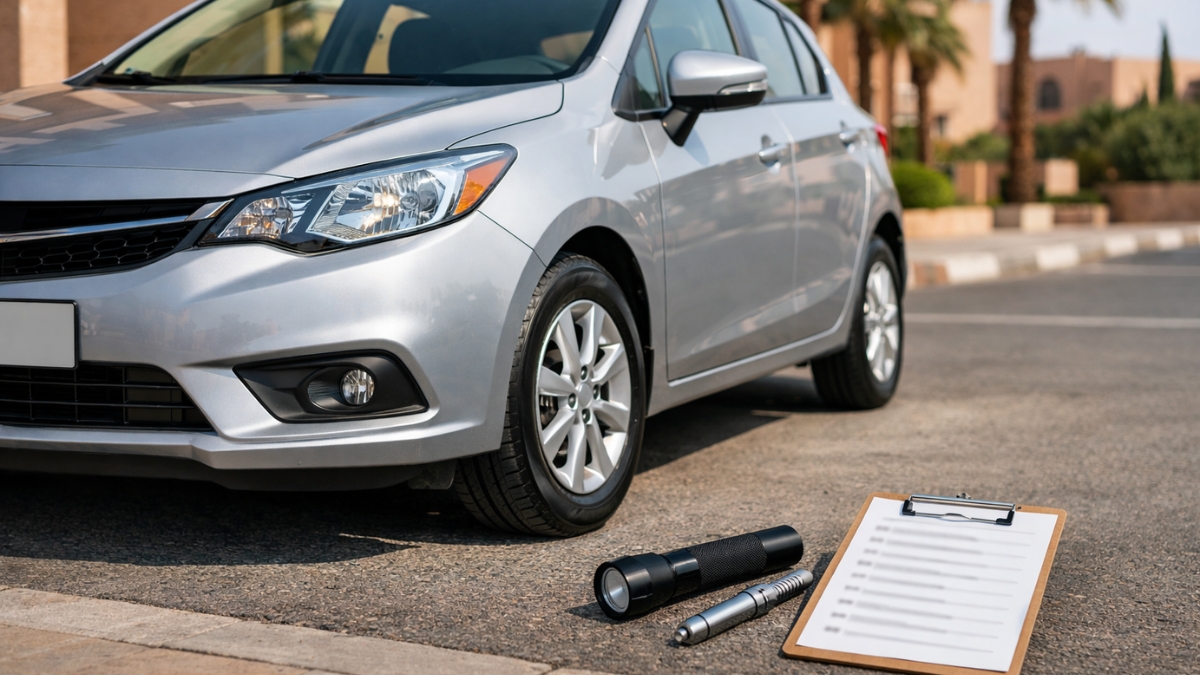
Damage disputes usually don’t happen because someone is “trying” to cause a problem. They happen because the pickup inspection was rushed, the photos were unclear, or the return check happened in bad light. In Marrakech, where many handovers happen at hotels, riads’ nearest parking spots, or airport curbs, your best protection is a simple, repeatable photo routine that takes 5–8 minutes.
This checklist is built around one rule: every photo must prove location + condition + scale. That means wide shots for context, close-ups for details, and angles that show whether a mark is a scratch, scuff, dent, or paint transfer.
Table of contents
- Before you start: two-minute setup
- The 20 photos to take at pickup
- Extra photos that help in Marrakech specifically
- How to take “dispute-proof” photos
- What to repeat at return
- FAQ
Before you start: two-minute setup
Do these first, before the driver hands you the keys and steps away:
- Clean your phone lens (seriously, smudges ruin “proof”).
- Turn off beauty filters / portrait blur for inspection shots.
- Use normal zoom (1x) for wide shots; use 2x–3x only for details.
- Take photos in good light. If it’s dark, ask to move under a lamp or use your flashlight for close-ups.
- Make sure time and date are correct on your phone.
Tip: If you want an easy way to confirm the exact time a photo was taken, you can check photo details on your phone. Apple explains where to see photo info on iPhone here: Apple Support: Find photos and videos on your iPhone. (Use it to confirm date/time and location when needed.)
The 20 photos to take at pickup
Take them in order. This keeps you fast and consistent.
1–4) Four wide “context” shots (walk-around)
- Front-left 3/4 wide shot (car + ground visible)
- Front-right 3/4 wide shot
- Rear-left 3/4 wide shot
- Rear-right 3/4 wide shot
These prove the overall condition and that you inspected the car at pickup.
5–8) Close-ups of bumpers and high-risk corners
- Front bumper center (grille area + lower lip)
- Front bumper left corner
- Front bumper right corner
- Rear bumper full width (step area where scratches happen loading luggage)
Bumpers collect small scrapes that turn into arguments later, make them crystal clear.
9–12) Wheels and rims (most common “gotcha”)
- Front-left wheel/rim (straight on)
- Front-right wheel/rim
- Rear-left wheel/rim
- Rear-right wheel/rim
Include the tire sidewall in the frame. If there’s curb rash, you want it obvious.
13–14) Windshield and glass
- Windshield wide shot (from outside, showing full glass)
- Windshield close-up of any chip, scratch, or wiper mark (if none, still take a clean close-up near the driver side)
Small chips can be missed in bright sun, tilt your angle slightly to catch reflections.
15–16) Roofline and mirrors
- Roof + upper side panels (stand back, capture roof edge and top of doors)
- Both side mirrors (one photo each or a wide shot that clearly shows both)
In Marrakech, tight parking and scooters make mirror scuffs surprisingly common.
17–18) Dashboard proof (engine off, then on)
- Mileage + fuel level (dashboard with ignition on)
- Warning lights check (photo right after you start the engineca, pture the cluster once it settles)
If a warning light stays on, photograph it clearly and mention it immediately.
19) Interior condition (the one that saves you from “stains”)
- Front seats + rear bench in one wide photo (doors open if possible)
If there are stains, tears, or burns, take extra close-ups (see “extras” below).
20) Trunk and spare kit
- Trunk open showing floor + spare/tire kit area (or where the kit should be)
If there’s no spare, that’s fine in many cars, but you want proof of what you received.
Extra photos that help in Marrakech specifically
These aren’t always required, but they’re worth it if the handover is quick or the car is parked in a tight spot.
- The rental agreement page that lists existing damage (if provided)
- Key(s) + remote (especially if you got two keys)
- Any existing scratch with a “scale” object (your finger, a coin, or the key fob, not a ruler with branding)
- Lower door edges and sills (dust hides scuffs)
- Underside front lip (speed bumps and ramps can scrape it)
If you want your photos to automatically back up so you don’t lose them, Google explains backup basics for Google Photos here: Google Photos Help: Back up photos & videos.
How to take “dispute-proof” photos
A photo only helps if it’s usable. Here’s what makes it strong:
- Do wide + close-up for the same area. Wide proves where on the car; close proves what it is.
- Angle matters. For scratches, shoot slightly from the side so the mark catches light.
- Avoid night blur. Brace your hands, use a stable stance, and take two shots if needed.
- Include the ground in some shots. It helps show the context at pickup (airport curb, hotel parking, etc.).
- Don’t rely only on video. Video is great, but a clear close-up still photo wins disputes.
- Send key photos immediately. If you’re using WhatsApp or email with the provider, sending the few “damage proof” images right away creates a timestamped record.
What to repeat at return
At return, you don’t need all 20 again, just the sections that most often create disagreements:
- 4 wide walk-around shots (same angles as pickup)
- Bumpers (front + rear)
- All four wheels/rims
- Windshield wide
- Fuel + mileage dashboard
- Trunk open
If the return is at night, insist on decent lighting. A two-minute move to a brighter spot is easier than a week of messages.
FAQ
1) How many photos is “enough” for a Marrakech rental pickup?
Twenty is a safe standard: four wide context shots, then close-ups of corners, wheels, glass, and the dashboard. It’s fast and consistent.
2) Should I take a video too?
Yes, do a slow 20–30 second walk-around video after the photos. But don’t skip close-up still images of wheels, bumpers, and windshield.
3) What’s the most common dispute area?
Wheels/rims and bumper corners. They get scraped easily and are hard to “prove” without clear close-ups.
4) What if the car is dusty and scratches are hard to see?
Use angled shots with reflections. If you see a suspicious area, take two angles and a close-up with your flashlight.
5) If I notice damage, what should I do on the spot?
Photograph it clearly, then message the provider immediately with the photo(s) and a short note like “Existing scratch on rear-right bumper at pickup.”
6) Do I need to photograph the fuel and mileage?
Yes. A clear dashboard photo avoids “fuel difference” and “extra km” misunderstandings, especially if your plan includes day trips.