
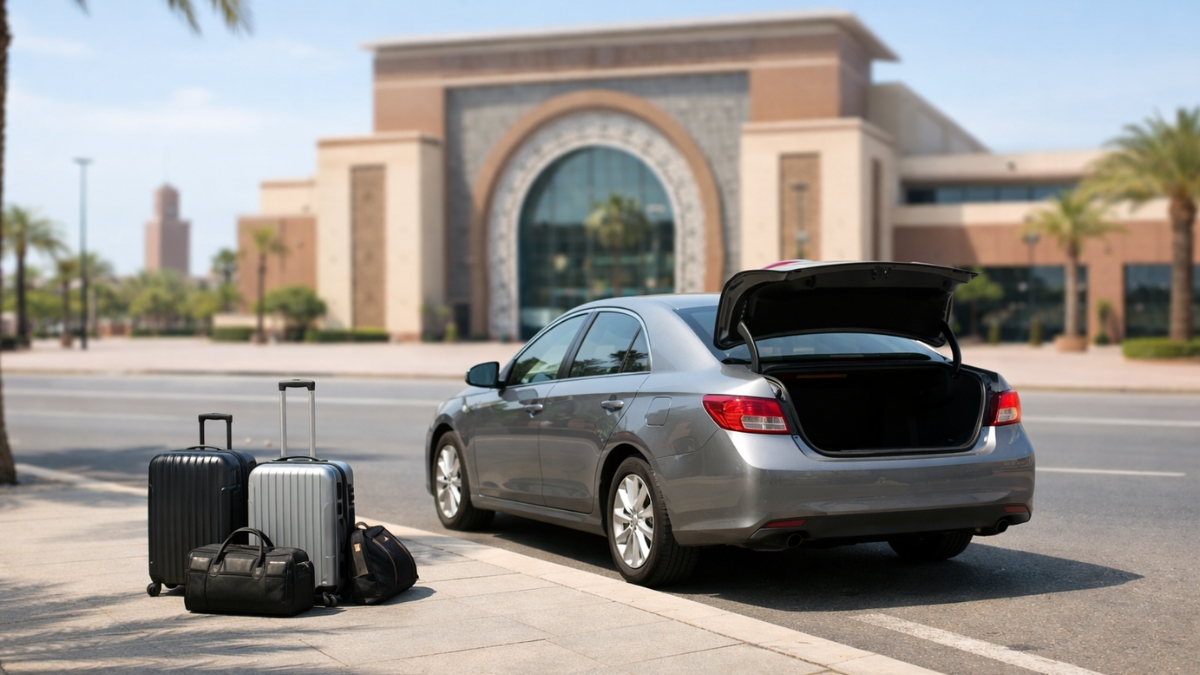
Picking up (or being picked up) at Marrakech ONCF Train Station is usually simple, until you arrive at the same time as two trains, a wave of taxis, and a dozen cars trying to “just stop for 30 seconds.” The station sits in a busy city zone, so the smoothest pickup is the one you plan like an airport pickup: clear meeting point, clear timing, and a backup parking plan.
This guide explains exactly where to meet, where drivers can park without chaos, how long it realistically takes to exit the station area, and what first-time visitors should expect.
Table of contents
- The 60-second plan for a smooth pickup
- Where to meet (best meeting points)
- Where to park (short stops vs real parking)
- What to expect when you arrive (taxis, luggage, exit flow)
- Timing tips (peak arrivals, delays, and waiting rules)
- Pickup by car vs pickup by driver: which is easier
- FAQ
1) The 60-second plan for a smooth pickup
If you only do one thing, do this:
- Choose one meeting point before the train arrives (not “we’ll find each other”).
- Share a live pin or exact map location so your driver doesn’t circle.
- Decide if the driver will stop briefly or park (two very different actions here).
- Set a time rule: “We meet 10 minutes after arrival,” not “right when the train stops.”
A small plan avoids the classic problems: missed calls inside the station, confusion at exits, and cars getting pushed out of the stopping zone.
Tip: If you want an official sense of what services (including access arrangements and station facilities) may be available, ONCF explains station services here: ONCF station services.
2) Where to meet at Marrakech ONCF station
Marrakech station has a clear main entrance area, but outside can be loud and crowded. These meeting points work best:
Best meeting point A: “Main entrance, outside the doors”
This is the simplest for first-time travelers:
- Easy to find
- Works well if you have luggage
- Visible for drivers doing a quick stop
How to make it reliable: agree on a specific spot just outside the entrance doors (example: “outside the main doors, to the right side, near the first open space away from taxis”).
Best meeting point B: “One-minute walk away from the busiest curb”
If the curb is packed with taxis and cars, step away:
- Walk 60–90 seconds along the sidewalk away from the densest taxi line
- Choose a calmer stretch where a car can pull in safely without blocking others
This reduces stress for everyone and often saves time overall (less circling, fewer horns, easier loading).
Best meeting point C: “Inside the station, only if the driver is on foot”
Meeting inside can work only if the driver is walking in to greet you. If they’re arriving by car, meeting inside usually delays things because:
- Calls can be missed
- People move slowly with bags
- The moment you exit, you’re still faced with the outside traffic problem
3) Where to park: short stop vs real parking
At Marrakech ONCF, “parking” can mean two things:
A) Short stop (quick loading)
This is when the driver:
- Pulls in
- Loads luggage
- Leaves immediately
What to expect: short-stop zones get busy fast. If the curb is packed, the driver may need to loop once and return.
Best practice: the passenger should be ready before the car arrives, bags closed, tickets done, no last-minute ATM run.
B) Real parking (waiting 10–30+ minutes)
If you want the driver to arrive early and wait comfortably, use real parking (when available) rather than circling.
Why it matters: circling costs time and money, and it increases stress in a busy zone. Parking turns “waiting” into something predictable.
How to decide:
- If the train is on time and pickup is immediate → short stop is fine.
- If the train can be late or you’re not sure when you’ll exit → real parking is better.
4) What to expect when you arrive
Taxi flow is intense
Outside the station, taxis cluster near the main exit. Even if you’re not taking a taxi, their flow affects how cars can stop.
What this means for you: if your driver can’t reach the exact curb, it’s normal. That’s why a backup meeting point (one-minute walk away) is so useful.
Bags and doors slow everything
A station pickup becomes slow when:
- People rearrange luggage at the curb
- Someone needs a cart last minute
- The car arrives but the passenger isn’t fully ready
The fastest pickups are boring: load and go.
Phone signal and noise can be a factor
Inside and right at the exit, it can be noisy. Simple messages help:
- “I’m outside. Right side. Blue suitcase.”
- “Walk 60 seconds forward; I’m by the calm curb.”
If you’re sending a map pin, Google Maps explains the basic “drop a pin and share” process here: How to drop a pin and share a place in Google Maps.
5) Timing tips: arrivals, delays, and waiting rules
Build a 10–15 minute “exit buffer”
Even if the train arrives on time, you might need time to:
- walk from platform to exit
- use the restroom
- regroup luggage
- navigate the crowd
A good rule: meet 10 minutes after scheduled arrival, not “at arrival time.”
Peak moments
Pickup becomes harder when:
- a train arrives and releases a crowd all at once
- late afternoon and early evening traffic increases in the area
If you can choose your pickup time, slightly off-peak is calmer.
If the train is delayed
The smart move is not constant calling, it’s a clear rule:
- “If delayed, message as soon as the train is moving again.”
- Driver waits in parking (best) or does timed loops (backup).
6) Pickup by car vs pickup by driver: which is easier?
Self-drive pickup works best if:
- you know the area
- you can handle quick curbside loading
- you’re comfortable doing one or two loops if the curb is blocked
A professional driver is better if:
- you arrive late or after dark
- you have family/extra luggage
- you want zero stress navigating taxi flow and curb timing
- you have a tight schedule and can’t risk confusion
Most travelers underestimate how tiring it is to coordinate pickup in a busy zone after a long train ride. A driver can turn it into a simple “walk out, load, go” moment.
7) FAQ
Where is the easiest place to meet at Marrakech ONCF station?
Just outside the main entrance doors is easiest, but a spot one minute away from the busiest curb can be faster if it’s crowded.
Can a car wait at the front curb for a long time?
Usually not comfortably. For longer waits, it’s better to use proper parking (when available) rather than circling.
How long should I expect from train arrival to getting in the car?
Plan 10–15 minutes on normal days, longer if it’s crowded or you have lots of luggage.
What if my driver can’t reach the exact front entrance?
That’s common. Use a backup meeting point a short walk away so the driver can stop safely.
Is it safe to load luggage at the curb?
Yes, but keep it fast: bags ready, doors open, load and go. Avoid reorganizing luggage in the pickup lane.
What’s the best way to share the meeting point?
Share a live pin or exact place link so the driver doesn’t guess and circle.