
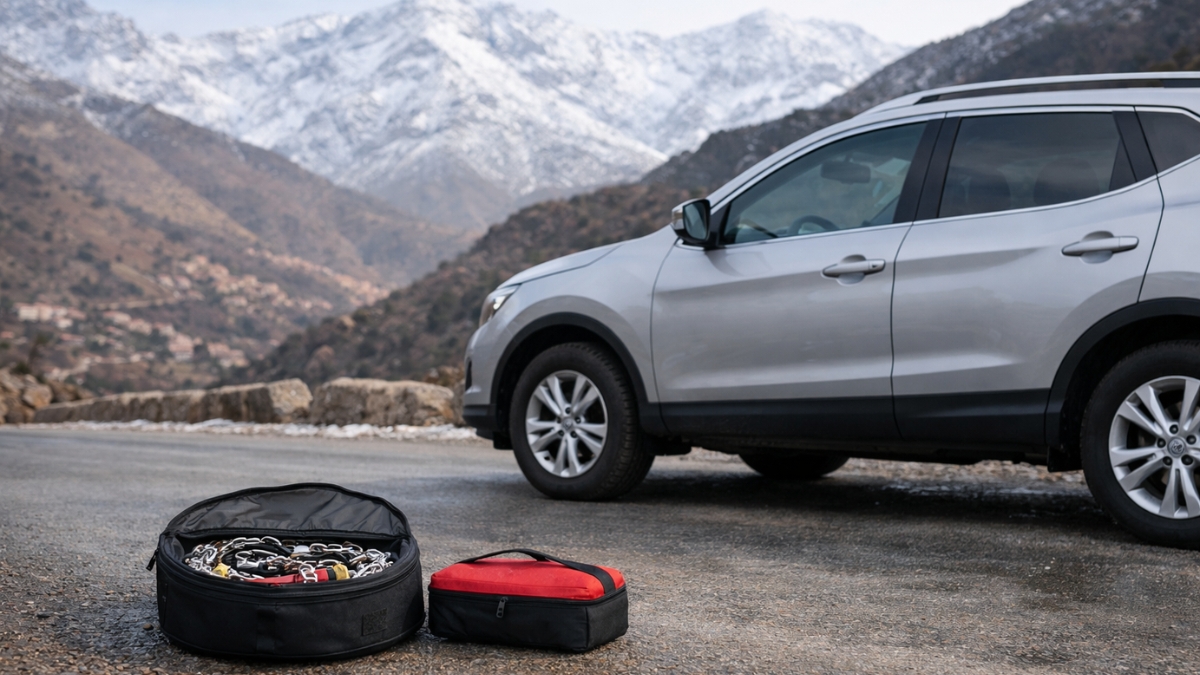
A winter drive from Marrakech to Imlil can be completely normal, dry pavement, sunny views, no drama. Then one weather change hits the High Atlas, and suddenly you’re dealing with ice patches, slow traffic, and drivers stopping to “figure it out” on the roadside. The real question isn’t “Do I need snow chains all winter?” It’s: Do I need them on the day I go, and how do I decide without guessing?
This guide gives you a practical 2025 approach: when chains are truly useful, how to check conditions before you leave, what kind of car makes sense, and when hiring a driver is the safer call.
Table of contents
- The route and where winter risk starts
- Are snow chains required by law on this road?
- When you actually need chains (real-world scenarios)
- How to check snow risk before you leave Marrakech
- Best car setup: 2WD vs 4×4, tires, clearance
- What to carry in the car for winter days
- When a driver is better than self-driving
- Winter timing: safest hours to drive
- FAQ
1. The route and where winter risk starts
Most trips follow the same pattern: Marrakech → Asni → Imlil. The first part near Marrakech usually feels like a standard regional road drive. Winter risk typically increases as you gain altitude and enter shaded mountain sections closer to Imlil.
What changes in winter is not “snow everywhere.” It’s micro-conditions:
- shaded corners that stay cold longer
- meltwater that refreezes overnight
- sudden flurries higher up even if Marrakech is mild
That’s why two people can drive on the same winter week and report totally different experiences.
2. Are snow chains required by law on this road?
In Morocco, chains can become mandatory when the road is signed/controlled for snow conditions. You may see temporary requirements during storms or right after snowfall, especially in mountain areas. The key point: it’s not a constant, all-winter requirement, it’s condition-based and can be enforced when needed.
A practical rule that matches how winter driving is communicated in Morocco:
- If authorities consider the road “snow/ice affected,” chains (or appropriate equipment) may be required for safe passage.
- National road-safety guidance explicitly mentions that winter conditions can require chains in some situations. You can see this in NARSA’s winter driving tips here: NARSA winter driving advice.
3. When you actually need chains (real-world scenarios)
Most travelers don’t need chains for a typical winter day. Chains become useful when at least one of these is true:
Scenario A: Fresh snowfall in the High Atlas (same day or night before)
If snow falls near Imlil or higher, you may encounter:
- slushy sections that turn slippery fast
- compacted snow near bends
- stop-and-go traffic where traction matters
Scenario B: “Clear road” but hidden ice in shaded sections
This is the sneaky one. Even without visible snow, you can get thin ice where water ran across the road and froze overnight, especially early morning and after sunset.
Scenario C: You’re in a low-clearance car and have to stop on a slope
A small car can still reach Imlil on many winter days, but traction becomes an issue if you must restart on a cold incline (traffic, roadworks, parked vehicles, etc.). Chains can be the difference between moving smoothly and getting stuck spinning wheels.
Scenario D: You plan to go early morning or return late
Colder temperatures = higher chance of ice. If you must travel at those times, you should plan more conservatively.
Best practical takeaway:
If there’s any snow/ice warning for the High Atlas around your travel date, bringing chains is cheap insurance, even if you never install them.
4. How to check snow risk before you leave Marrakech
Don’t rely on Marrakech weather. Check warnings specifically for mountain conditions.
Step 1: Check official weather warnings for snow
Morocco’s official weather vigilance platform is the fastest way to see if snow/ice conditions are expected in mountain regions. Start here: MarocMétéo Vigilance (official warnings).
Step 2: Decide with a simple “go / go prepared / don’t go” rule
- Go: clear conditions, no snow warnings, daytime travel
- Go prepared: any snow/ice warning in mountain areas, or recent snowfall, or very cold nights
- Don’t go (or go with a driver/4×4): active snow event, poor visibility, or you’re not comfortable installing chains and driving on slick bends
5. Best car setup: 2WD vs 4×4, tires, clearance
For most winter days, a normal 2WD car is fine. The better question is how tolerant you want to be of surprises.
2WD is usually fine if:
- you drive in daylight
- forecasts show no mountain snow risk
- you’re okay going slow on the final climbs
- you avoid very early morning / late-night timing
Consider 4×4 (or a driver with a suitable vehicle) if:
- snow is forecast for the High Atlas
- you’re traveling with family, luggage, or a tight schedule
- you don’t want to deal with “maybe it’s icy around the next bend” stress
About tires
Most rental cars won’t come with winter tires unless specifically arranged. So your “traction tools” are basically:
- careful driving + timing
- chains (if you bring them or request them)
- choosing a vehicle better suited to winter mountain conditions
6. What to carry in the car for winter days
Even on a short route, mountains can change quickly. Keep this simple kit:
- warm layer (even if Marrakech is mild)
- water + small snacks
- phone power bank / charging cable
- flashlight
- windshield washer fluid (good visibility matters)
- a small microfiber cloth for fogging/condensation
- chains only if weather risk exists (and practice the basic idea of fitting them before you need to do it under stress)
7. When a driver is better than self-driving
A driver isn’t just about comfort. On winter mountain days, it’s about removing the two hardest parts: decision stress and traction management.
Choose a driver when:
- you’re arriving after dark or leaving before sunrise
- you have family in the car and want safety-first decisions
- you’re not confident installing chains quickly
- you have a schedule you can’t miss (hotel check-in, guided hike start, etc.)
- warnings show possible snow/ice in the Atlas
If you’re thinking “I can do it, but I’d rather not,” that’s usually the correct moment to choose a driver.
8. Winter timing: safest hours to drive
If you want the lowest-risk timing in winter:
- Safest: late morning to mid-afternoon
- Higher risk: early morning (coldest, more ice) and evening/night (temperature drop + reduced visibility)
If there was snowfall the previous night, wait for daylight and some warming before heading up.
FAQ
Do I need snow chains from Marrakech to Imlil in winter 2025?
Not always. Most winter days you won’t need them, but on snow/ice warning days or after snowfall, chains can be the difference between an easy climb and wheel spin on cold slopes.
How do I know if snow is expected near Imlil?
Check official warnings before you leave using the MarocMétéo Vigilance page, then plan your timing for daylight.
Is a 4×4 required to reach Imlil in winter?
No on many days. But if snow/ice is expected, a 4×4 (or a professional driver with the right vehicle) is the safer, lower-stress option.
Can the road be icy even if Marrakech is warm?
Yes. Altitude and shade near Imlil can create ice patches even when the city feels mild.
What’s the safest time of day to drive to Imlil in winter?
Late morning to mid-afternoon is usually safest. Early morning and night are riskier due to colder temperatures and possible ice.
What if I don’t know how to fit chains?
If conditions suggest you might need them and you’re not comfortable fitting them, it’s smarter to choose a driver or a vehicle setup that reduces that risk.