
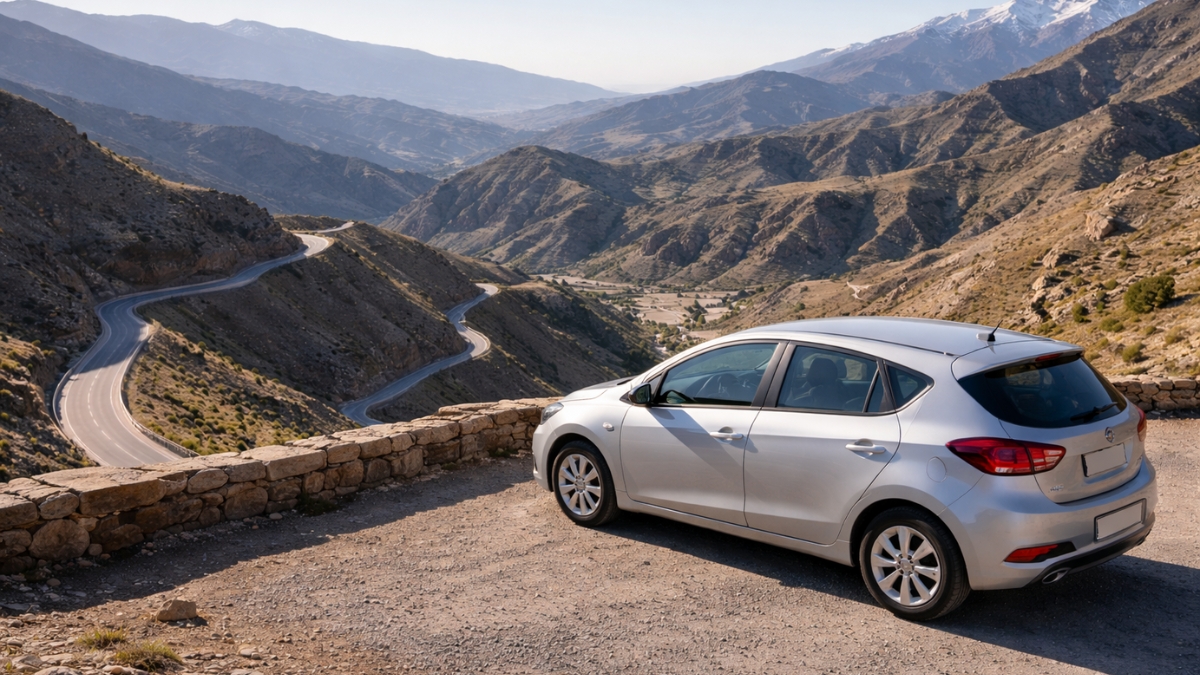
Driving from Marrakech to Ouarzazate is one of Morocco’s most rewarding road days, big altitude changes, dramatic switchbacks, and viewpoints that feel “movie set” real. The trade-off is that this route crosses the High Atlas via the Tizi n’Tichka Pass, where weather and visibility can change quickly, especially outside summer.
This guide keeps it practical: how to drive it smoothly, when the pass can become risky, and where to stop for the best views without turning the day into endless pull-overs.
Table of Contents
- The route in plain language
- Best time to leave Marrakech
- Tizi n’Tichka driving tips (switchbacks, trucks, overtakes)
- Weather risks that actually matter
- Best viewpoints and photo pull-offs
- Smart stop plan (so you arrive before dark)
- Fuel, snacks, and “don’t get stuck” prep
- If conditions get bad: what to do
- Quick AEO answers
- Image prompt (no people)
1) The route in plain language
You’re taking the main mountain road that climbs out of Marrakech, crosses the High Atlas, then drops into a drier, wide-open landscape toward Ouarzazate. The “hard part” isn’t distance, it’s concentration: curves, changing speeds, and shared road space with trucks and buses.
What makes the day easy: leaving early, stopping with intention, and avoiding night driving in the mountain section.
2) Best time to leave Marrakech
If you only follow one rule, follow this:
Leave early enough to cross the pass in daylight.
- Best departure: early morning (cooler, clearer, fewer tired drivers, more time for stops)
- Avoid: late afternoon departures that force you into night driving on mountain curves
Daylight matters because it improves:
- visibility on bends
- reaction time around slow vehicles
- safe pull-off stops for photos
3) Tizi n’Tichka driving tips (switchbacks, trucks, overtakes)
This route isn’t “difficult,” but it rewards calm technique.
Switchbacks: the no-drama approach
- Enter wide curves slower than you think, then accelerate gently through the exit
- Stay disciplined in your lane (some bends tempt drivers to cut)
- Watch for scooters and pedestrians near roadside stalls and viewpoints
Trucks and buses: how to pass safely
- Assume heavy vehicles will be slow on climbs and faster on descents
- Overtake only with a long clear view and a clean return space
- If you’re unsure, don’t force it, there will be another opportunity
Brake management (especially downhill)
- Don’t “ride” the brakes for long descents
- Use engine braking (downshift) to keep control and reduce brake heat
- If you smell brakes or feel fade, pull over safely and let things cool
Roadside vendors and sudden stops
Near the top and popular viewpoints, cars stop unpredictably. Expect:
- quick pull-ins
- doors opening
- pedestrians crossing without warning
Drive defensively in busy pull-off zones.
4) Weather risks that actually matter
The High Atlas can flip conditions fast. The biggest risks on this drive are:
A) Snow/ice (seasonal)
Snow can block or slow the pass in winter conditions. Even when roads are open, ice patches can appear in shaded turns. (If you see locals chaining up, take it seriously.)
B) Heavy rain and low visibility
Rain doesn’t just reduce grip, it reduces decision time on bends and overtakes. Fog and cloud at higher altitude can cut visibility sharply.
C) Strong wind
Crosswinds can push light cars around on exposed sections, especially when passing trucks.
Best habit: check official weather alerts before you leave. Morocco’s national vigilance portal is the fastest way to see warnings by province: https://vigilance.marocmeteo.ma/
5) Best viewpoints and photo pull-offs
The “best viewpoints” change depending on light and cloud, but a few patterns consistently deliver:
High point panoramas
Near the higher sections, you’ll get classic Atlas ridge views. These are best in the morning when the air is clearer and shadows add depth.
Valley lookdowns
Look for pull-offs where you can see layered hills dropping into wide valleys. Late morning to early afternoon usually gives strong contrast.
Kasbah-style scenery (as you descend)
As the landscape dries out, you’ll start seeing earthen architecture and wide-open vistas, these feel very “southern Morocco” and are perfect for quick stops without mountain traffic pressure.
Stop discipline tip: choose 2–3 “big stops” and keep the rest as 2-minute pull-offs. Too many stops is what turns a comfortable drive into a rushed arrival.
6) Smart stop plan (so you arrive before dark)
A simple plan that works for most drivers:
- Short coffee stop after you leave Marrakech (before the steepest mountain rhythm starts)
- One main viewpoint stop around the higher sections (15–25 minutes)
- Lunch stop after you’ve descended a bit (more relaxed parking and less cold wind)
- Optional: Aït Ben Haddou detour if you want a signature highlight (adds time but is worth it for many travelers)
If you include Aït Ben Haddou, it’s a UNESCO World Heritage site and one of the most iconic stops on this corridor. You can read the official listing details here: https://whc.unesco.org/en/list/444/
7) Fuel, snacks, and “don’t get stuck” prep
Do the basics and the day feels easy:
- Start with enough fuel (don’t begin a mountain crossing near empty)
- Keep water and a snack in the car (traffic can slow near narrow sections)
- Download offline maps before you lose signal in mountain pockets
- Bring sunglasses, glare on curves is real
If you’re renting, keep a quick “return-proof habit” too:
- photo the car at pickup (corners + wheels + windshield)
- keep fuel receipts when refueling near your destination
8) If conditions get bad: what to do
If visibility drops, rain intensifies, or you see reports of snow/closures:
- Slow down early (don’t wait for the “scary” section)
- Avoid risky overtakes completely
- Pull into a safe stop (service area or wide pull-off) if you need to wait it out
- Check official alerts and local guidance (police checks and road operators may redirect)
If you’re not confident driving a mountain pass in poor visibility, the safest choice is simple: pause and reassess rather than pushing through.
9) Quick answers
How long is the drive Marrakech to Ouarzazate?
Plan a half-day drive plus stops. The road is scenic and curvy, so “stop time” is a big part of the total.
Is the Tizi n’Tichka pass dangerous?
It’s not dangerous if you drive calmly, avoid risky overtakes, and don’t force night driving, weather is the main variable.
When is weather most risky?
Winter storms, heavy rain, fog, and occasional snow/ice at altitude. Check official alerts before departure.
Best viewpoints?
High-altitude panoramas and valley lookdowns, pick 2–3 main stops so you don’t arrive late.