
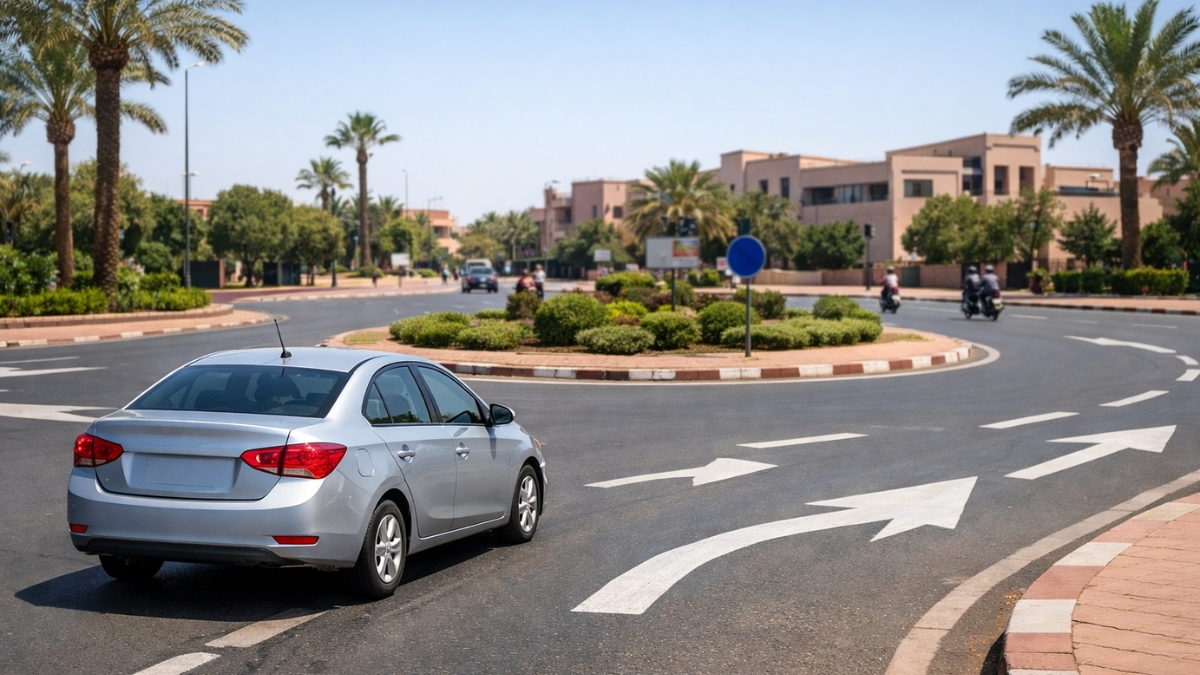
Marrakech roundabouts can feel intimidating at first, not because they’re “impossible,” but because they move fast, drivers commit early, and hesitation gets punished with horns. The good news: once you understand the right-of-way logic, lane expectations, and a few stress-saving habits, roundabouts become predictable.
This guide explains the rules tourists most often misunderstand, how to read the signs and road markings you’ll actually see in Marrakech, and how to drive with confidence without trying to “out-aggress” local traffic.
Table of contents
- Why Marrakech roundabouts feel harder than they are
- The two “roundabout types” tourists confuse
- Right-of-way: what to follow when signs differ
- Lane choice: the mistake that triggers most honks
- Signals, speed, and spacing: the calm-driver formula
- Common tourist errors (and the low-stress fix)
- When you should avoid driving and choose a driver
- FAQ
1. Why Marrakech roundabouts feel harder than they are
In many countries, roundabouts run on one “universal” habit: yield on entry, then flow. In Marrakech, you’ll still see that pattern—but you’ll also encounter places where signage, traffic lights, or lane discipline changes the vibe. Add mopeds slipping through gaps, taxis changing lanes late, and visitors braking too hard… and it becomes stressful.
What works best here is not “being brave.” It’s being clear:
- Choose your lane early
- Keep a steady pace
- Signal with intention
- If you miss your exit, go around again (no shame, no drama)
2. The two “roundabout types” tourists confuse
A big source of confusion in Morocco is that people casually call everything a “roundabout,” even though the rules can depend on signs and markings.
A helpful official explanation is the Moroccan road-safety authority’s guidance on distinguishing roundabout situations by markings and “yield” signage: NARSA on roundabout vs circular intersection.
In practical Marrakech terms, you’ll usually face one of these:
Type A: Yield-on-entry (most common in modern layouts)
You’ll see a yield sign and markings that tell you to give way to vehicles already circulating.
Type B: Priority can vary (older layouts or sign-light combinations)
Some circles are managed by lights or different priority signage. If there are traffic lights, treat it like a controlled junction: green means go, red means stop, even if you’re already inside the circle.
3. Right-of-way: what to follow when signs differ
Use this order of priority (it keeps you out of arguments and out of trouble):
- Traffic lights (if present)
- Police officer directing traffic (if present)
- Yield/Stop signs + road markings
- If unclear: drive defensively and assume someone may not yield
In most Marrakech roundabouts with clear yield signage, the safe assumption is: vehicles already circulating have priority and entering traffic waits for a safe gap.
Stress tip: When you’re approaching and unsure, slow slightly early, scan left, and commit only when you see a clean gap. “Half-commit” (rolling in and then stopping suddenly) is what triggers horns and near-misses.
4. Lane choice: the mistake that triggers most honks
Tourists often enter in the wrong lane, then try to fix it inside the roundabout. That’s where stress explodes.
A simple lane logic that works in many Marrakech roundabouts:
- Right lane: first exit, or going “straight” (depending on markings)
- Left/inner lane: turning left, or taking later exits / making a big loop
But here’s the key: always obey arrows and markings, because some roundabouts assign lanes differently.
Low-stress rule:
- If you’re not 100% sure which lane is correct, choose the safer, slower option: right lane + go around again if needed.
Going around twice is normal. Cutting across lanes late is what causes chaos.
5. Signals, speed, and spacing: the calm-driver formula
Signaling
Use signals early and clearly:
- Signal right when you’re preparing to exit
- If you’re moving from inner to outer lane to exit, signal and wait for space
If you want a familiar reference for roundabout signaling discipline (even if your home country differs slightly), the UK Highway Code roundabout guidance is a good reminder of the “signal early, exit safely” mindset: UK Highway Code: roundabouts.
Speed
A steady, moderate speed is safer than braking hard:
- Enter smoothly
- Keep rolling if the lane ahead is clear
- Don’t stop inside the circle unless required (lights, blockage, or safety)
Spacing
Leave extra space in front:
- Mopeds may appear in gaps you didn’t plan for
- Taxis may change lane late
- Your buffer buys you calm choices
6. Common tourist errors (and the low-stress fix)
Mistake 1: Hesitating too long at the entry
Fix: Decide before the line, either stop fully and wait, or go cleanly. No “creeping.”
Mistake 2: Entering fast, then braking inside
Fix: Slow slightly before entry, then maintain a steady roll.
Mistake 3: Switching lanes late to catch an exit
Fix: If you miss it, go around again. It’s faster than a near-miss.
Mistake 4: Not signaling the exit
Fix: Signal right as you pass the exit before yours (when safe to do so).
Mistake 5: Following the car ahead blindly
Fix: Watch lane arrows and your own exit. Marrakech drivers may take unexpected exits.
Mistake 6: Trying to “win” against assertive drivers
Fix: Drive predictable. Predictable beats aggressive every time.
7. When you should avoid driving and choose a driver
Sometimes the best stress-reduction strategy is not a better technique, it’s a different plan.
Consider a driver if:
- You’re arriving at peak traffic hours (late afternoon/evening)
- You’re not comfortable with quick merges and lane changes
- You’re traveling with family, lots of luggage, or tight timing
- You need to navigate multiple roundabouts near busy districts in one trip
A professional driver turns roundabouts into “background noise” while you focus on your day.
FAQ
1) Do cars already in the roundabout always have priority in Marrakech?
Often yes, especially when you see yield signs and markings on entry. If there are traffic lights, follow the lights.
2) What if there’s no clear sign at the entry?
Treat it as high-uncertainty: slow down, yield defensively, and enter only with a clear safe gap.
3) Which lane should I use to go straight?
It depends on arrows and markings. Many roundabouts allow straight from the right lane, but always follow painted arrows.
4) Is it okay to go around the roundabout twice?
Yes. It’s common and safer than cutting across lanes late to catch an exit.
5) When should I signal to exit?
Signal right as you pass the exit before yours (when safe), then move outward carefully and exit smoothly.
6) Are mopeds allowed inside roundabouts?
Yes, and they may filter through tight spaces. Keep extra spacing and avoid sudden lane changes.