
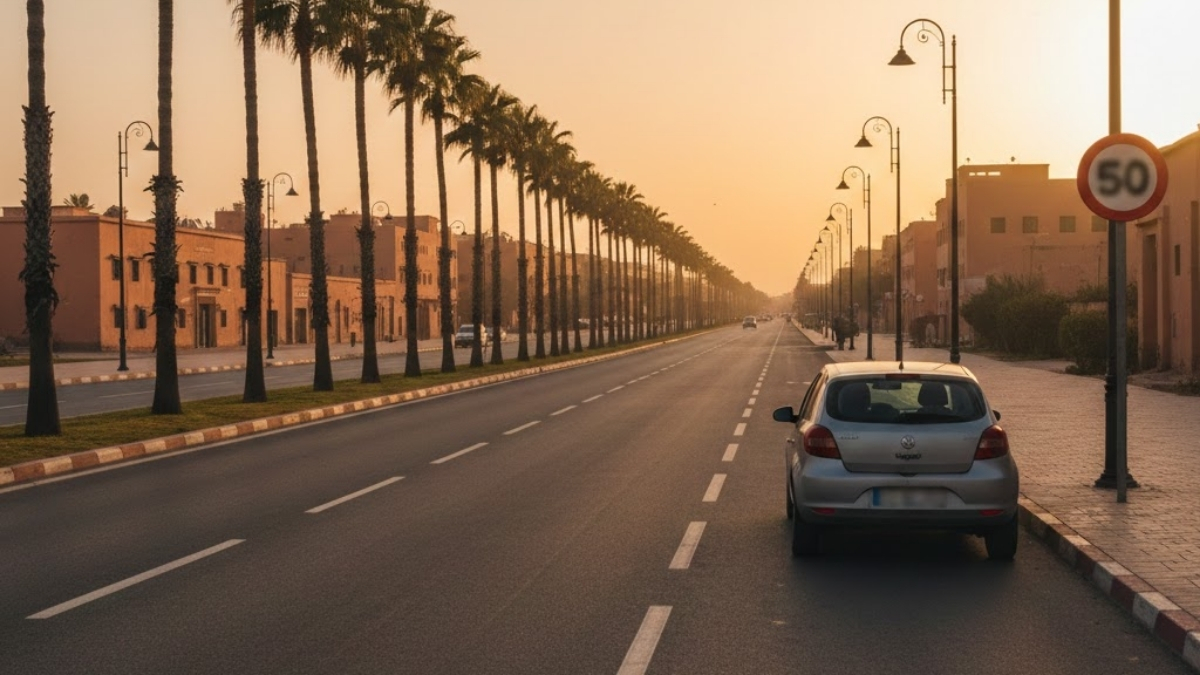
Marrakech driving is usually manageable, but speeding tickets are one of the most common “unexpected costs” for visitors, mainly because the city has several roads that feel faster than the posted limit. Long, straight boulevards, wide entrances to the city, and “in-between” connector roads are exactly where drivers drift above the limit without noticing. That is also where enforcement is most likely.
At MarHire Car Marrakech, most fines come from small over-speeding (not extreme speeding): drivers follow the flow, miss a speed drop after a roundabout, or keep “open-road speed” while already back in an urban zone. This guide explains where speed cameras are most commonly encountered around Marrakech, what limits to expect, and how fine payment typically works.
Table of Contents
- Quick Overview
- Where Speed Cameras Are Most Common Around Marrakech
- Typical Speed Limits You’ll See Around Marrakech
- The “Limit-Change Traps” That Catch Tourists
- Fine Basics: How Speeding Penalties Scale
- Fine Payment Basics: Timing, Discounts, and What You’ll Need
- A Simple No-Fine Driving Routine for Marrakech
- FAQ
Quick Overview
- Expect enforcement on city entrances, major boulevards, fast connectors, and approaches to the airport, especially where limits change quickly.
- In Morocco, posted limits commonly include 20/40/60 km/h in built-up areas, 80 or 100 km/h on national roads, and 120 km/h on motorways.
Speeding penalties scale by how much you exceed the limit (small excesses can still generate fines).
For “radar” fines, Morocco’s official online payment channel is the Trésorerie Générale du Royaume (TGR) e-recouvrement portal, which also explains time windows and discount logic. https://www.tgr.gov.ma/wps/portal/erecouvrement
For official speed-limit context and how sanctions are structured, NARSA’s guidance is here: https://www.narsa-securiteroutiere.ma/fr/la-vitesse-excessive/
Where Speed Cameras Are Most Common Around Marrakech
Camera placement can change over time, and you should not rely on one “permanent map.” What stays consistent is the pattern of where enforcement makes sense. In Marrakech, you’ll most often encounter speed enforcement in these environments:
1) City entrances and exit corridors
These are the classic “I didn’t notice the change” zones. You leave a faster section, then hit a controlled urban corridor where the limit drops. Drivers get caught because they slow down late.
What it looks like:
- wide approach roads that suddenly become more urban
- more junctions, more signage, more lighting
- more police presence and controlled traffic flow
2) Major boulevards inside the city
Marrakech has multiple wide boulevards that feel comfortable at higher speeds, until you realize they are still urban zones. Cameras (and enforcement in general) tend to be more common on:
- long straight stretches with few interruptions
- sections where drivers accelerate between lights
- roads with frequent “speed harmonization” (limit changes depending on zone)
3) Fast connectors between districts
When you move between areas such as the modern city, hotel zones, and outer districts, you often take connector roads designed to move traffic quickly. These roads create “silent speeding” because:
- lanes are wide
- traffic is flowing
- drivers match the fastest car, not the sign
4) Airport approach routes
Airport drives encourage “cruise mode,” especially if you are running late. That combination, open road + time pressure, is one of the most common speeding-fine recipes.
Smart rule: treat any airport approach as a limit-change corridor.
5) School-adjacent and pedestrian-heavy zones
Even if you do not see a camera, enforcement focus is often stronger where risk is higher:
- near schools, dense crosswalk areas, and busy roundabouts
- zones where the limit drops to reflect pedestrian exposure
These are also the zones where “only 10 km/h over” becomes expensive.
Typical Speed Limits You’ll See Around Marrakech
You should always follow the posted signs on the road you are actually on. As a practical baseline, NARSA’s guidance highlights typical Moroccan speed-limit ranges: 20/40/60 km/h in built-up areas (depending on the zone), 80 or 100 km/h on national roads depending on the segment, and 120 km/h on motorways.
How to use that in Marrakech:
- If you are clearly “inside the city,” expect urban limits even if the road looks like a mini-highway.
- If you are on a main road leaving Marrakech toward another region, you may transition into national road limits, then back down again when you pass built-up pockets.
- Motorways are the most consistent, until you approach interchanges and urban approaches where behavior changes.
The “Limit-Change Traps” That Catch Tourists
Most Marrakech speeding tickets happen at predictable moments:
- Right after a roundabout
Drivers accelerate to “re-join flow” and miss the next speed sign. - Downhill sections
Your speed rises without you noticing, especially on smooth surfaces. - “Empty road at night” confidence
Lower traffic makes your speed feel safer, enforcement does not disappear. - Airport timing pressure
When you feel late, you drive faster, exactly when you should drive calmer. - Switching road types too quickly
Motorway → national road → urban can happen within a short span. If you don’t reset your “expected limit,” you get caught.
Fine Basics: How Speeding Penalties Scale
NARSA summarizes that speeding sanctions depend on the amount by which you exceed the authorized limit. In general terms:
- under 20 km/h over is treated differently than 20–30 km/h, 30–50 km/h, and 50+ km/h (which can become a more serious offense).
This is why “small speeding” is not harmless: the thresholds are designed to penalize incremental excess, not only extreme cases.
Fine Payment Basics: Timing, Discounts, and What You’ll Need
If a radar-recorded infraction is issued as an ATF (transactional lump-sum fine), the practical advice is:
1) Do not wait until the end of your trip
The TGR portal explains that ATF availability on the portal is time-bound and that payment timing can affect the amount (discount logic exists depending on when you pay).
2) Use the official payment channel
The official online payment channel is the TGR e-recouvrement portal (used for road-fine payments and other payments):
https://www.tgr.gov.ma/wps/portal/erecouvrement
3) Have the right details ready
In practice, you typically need the information shown on the notice (or equivalent reference details) to locate the fine in the system. If you are in a rental, keep your paperwork organized so you can confirm:
- vehicle plate information
- contract/rental details
- any reference identifiers provided in a notice (if applicable)
4) Understand discount windows (high-level)
The portal notes that reductions can apply depending on payment delay (the site describes percentage reductions and different payable amounts depending on timing and class).
Practical takeaway: early resolution is usually cheaper and simpler than late resolution.
A Simple No-Fine Driving Routine for Marrakech
If you follow this routine, you avoid most camera-related surprises:
- Read every speed sign as a “new rule,” not a suggestion
- After every roundabout: check speed + scan for the next sign
- On long straight boulevards: pick a steady number and hold it
- Near the airport: assume limit changes and drive calmer, not faster
- Do not chase local speed, copy the posted speed
- Build time buffer so you never feel rushed
- If unsure: drive as if enforcement is present (because it often is)
FAQ
Are speed cameras common around Marrakech?
You should assume enforcement is common on major boulevards, entrances/exits, and fast connectors, especially where limits change.
What limits should I expect in and around Marrakech?
Always follow posted signage. As general guidance, NARSA notes 20/40/60 km/h in built-up areas depending on zone, 80 or 100 km/h on national roads depending on segments, and 120 km/h on motorways.
Do fines depend on how much I exceed the limit?
Yes, sanctions scale by the amount of excess speed.
Where do tourists get caught most often?
Typically at limit changes: after roundabouts, at city entrances, and on wide roads that feel faster than the posted limit.
Can I pay a radar fine online?
Yes. The official online payment channel is the TGR e-recouvrement portal