
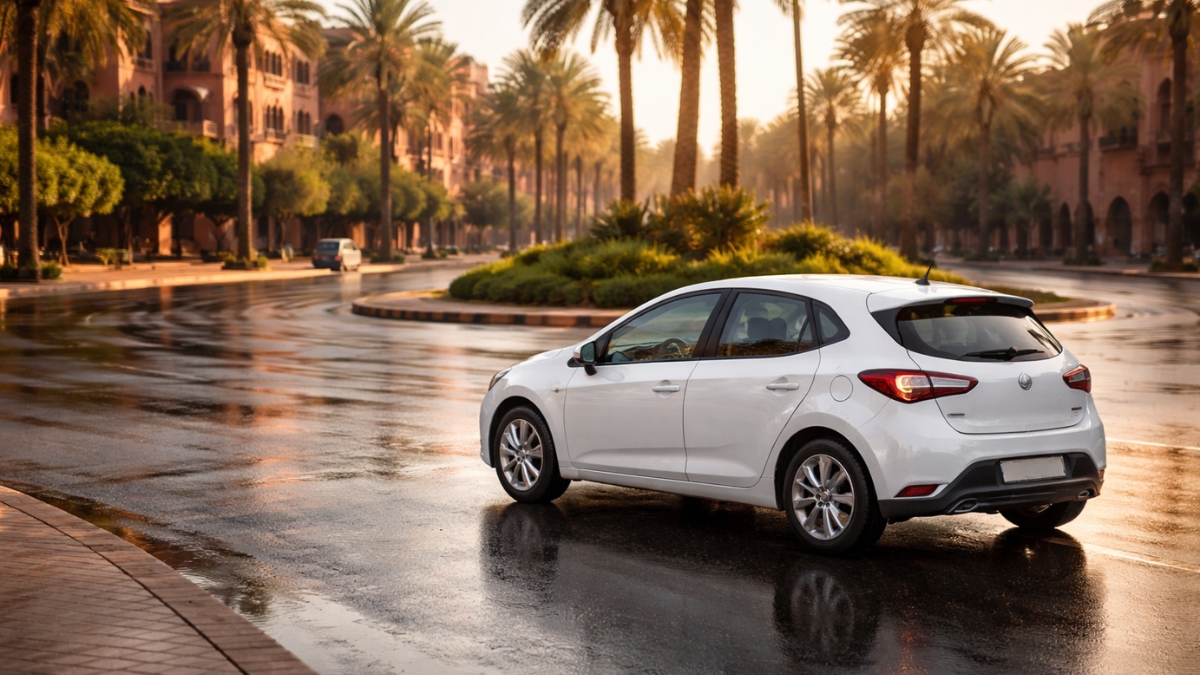
Marrakech can feel “easy” one hour and chaotic the next. The difference usually isn’t distance, it’s timing. Between school runs, commute peaks, market activity, prayer-time movement, and evening outings, the same 3 km can take 10 minutes or 40.
This guide breaks down Marrakech traffic by time of day, then shows you when it’s smarter to park once and walk, especially around the medina edges, Jemaa el-Fna, and Gueliz. It’s designed for visitors who want to move efficiently without turning every errand into a parking mission.
Table of contents
- The daily rhythm of Marrakech traffic
- Early morning: best time to reposition
- Morning peak: when driving becomes slow
- Midday: short windows that work
- Afternoon: school pickup and shopping surges
- Evening peak: the “second rush”
- Late night: smoother roads, different risks
- Where to park and walk
- Smart navigation settings that actually help
- FAQ
1. The daily rhythm of Marrakech traffic
Marrakech traffic is shaped by a few repeat patterns:
- Concentrated choke points (roundabouts, key boulevards, medina gateways)
- Mixed road users (cars, scooters, taxis, pedestrians, delivery vehicles)
- Short trips that stack up (many people moving in the same 2–4 km core)
Instead of fighting it, plan your day around two ideas:
- Reposition early (get near your target area before the peak)
- Park once (do multiple stops on foot in a compact zone)
2. Early morning (06:30–08:00): best time to reposition
If you need to move across town, hotel to Gueliz, Gueliz to a medina edge, or heading out toward highways, early morning is your friend.
What works well now
- Crossing town before the first big wave
- Quick drop-offs and short errands
- Getting out of the center toward major roads
Best strategy
- Move first, park second.
If your plan includes the medina area later, use this window to get close, park, and start your day on foot.
3. Morning peak (08:00–10:00): when driving becomes slow
This is one of the most consistently busy windows, driven by school schedules and work commutes.
What feels slow
- Roundabouts and major boulevards
- Any short trip that requires a left turn or multiple merges
- Anything that involves “just finding parking”
What to do instead
- If you’re heading to the medina, treat it like a walking zone: park on the edge and walk in.
- If you’re in Gueliz, do errands in one area instead of bouncing between neighborhoods.
4. Midday (10:00–12:30): short windows that work
Late morning often opens up a bit. Roads can still be active, but it’s usually more predictable than the peaks.
Good uses for this window
- Moving between districts (Gueliz ↔ Hivernage ↔ medina edge)
- Short drives to a specific parking plan
- Quick exits toward intercity routes
Tip
- Keep your “parking plan” fixed. If you start improvising, midday can still turn into a time sink.
5. Lunch and early afternoon (12:30–15:30): mixed conditions
This period can be surprisingly variable. Some streets calm down; others stay busy due to deliveries, shopping, and mid-day movement.
When driving can work
- If you’re going point-to-point with a clear destination and realistic parking
- If you’re heading out of the city for a day trip
When to park and walk
- If your plan includes browsing, photos, cafés, or multiple stops in the center
- If you’re near medina gateways, circling for a perfect spot wastes time fast
6. Afternoon surge (15:30–17:30): school pickup + errands
This is the “quietly intense” period. Even if roads aren’t gridlocked everywhere, small bottlenecks spread quickly.
Best move
- Avoid crossing the city during this window unless you must.
- If you’re already near your target area, stay there, walk, café, short loop, then drive after the wave.
7. Evening peak (17:30–20:00): the second rush
Many visitors underestimate this. As locals finish work and evening plans begin, popular zones tighten up.
What gets hard
- Parking near busy dining/shopping areas
- Short drives that require turning across traffic
- Roundabouts and main corridors
Best strategy
- If you’re going to dinner or a popular spot: arrive earlier, park once, and walk.
- If you must drive: choose a destination with predictable parking rather than “we’ll figure it out.”
8. Late night (20:00–23:30): smoother roads, different risks
Late evening is often calmer for driving, but you should adjust your mindset:
- Expect faster-moving traffic on open stretches
- Stay extra alert near crossings and scooters
- Don’t let “clear roads” push you into rushing
If you’re returning to your accommodation late, this is a good time to drive back, especially if you already parked earlier and are just retrieving the car.
9. Where to park and walk (the stress-saving rule)
Marrakech is easiest when you separate “driving zones” from “walking zones.”
Walking zones (park once, do everything on foot)
- Medina interior (treat it like a pedestrian-first area)
- Jemaa el-Fna and surrounding souks (walking is the point)
Driving zones (easier for point-to-point)
- Many parts of Gueliz and wider boulevards
- Hotel-to-highway movement (leaving the city)
Practical approach
- Pick a parking area near the edge of what you want to visit, then make a loop on foot: sights, shopping, café, photos, and return.
One parking decision beats four “quick” drives that turn into four searches.
10. Smart navigation settings that actually help
If you rely on navigation, use it as a timing tool, not just directions:
- Check traffic colors before you start a cross-city move
- Compare ETAs between “fastest” and “simple turns” routes
- Avoid last-second reroutes that cut through tight local streets unless you know them well
To enable the traffic view, you can use the official Google Maps instructions for showing the traffic layer: https://support.google.com/maps/answer/3092439
If you like checking how congestion trends compare across cities worldwide (useful context, not a route planner), TomTom’s global index is here: https://www.tomtom.com/traffic-index/
FAQ
What are the worst hours to drive in Marrakech?
Most days, the slowest periods are the morning commute window and the early evening rush. If you can shift cross-city driving outside those peaks, the trip often feels twice as easy.
When is the best time to drive to the medina area?
Early morning is usually best. Get close, park, and walk in. Trying to “drive inside the experience” later often turns into circling and frustration.
Should I drive between attractions inside the center?
If the stops are close, it’s usually faster to park once and walk, especially for medina-side plans. Driving short distances can take longer than walking because of turns and parking.
Is late night driving easier?
Traffic is often lighter, but pay attention to faster speeds and scooters. Keep a calm pace and assume someone may merge unexpectedly.
How do I avoid wasting time on parking?
Decide your parking area before you leave. One planned parking choice plus a walking loop beats multiple “quick” drives.
When is a driver the better option in Marrakech?
If you’re arriving during peak hours, traveling with family, carrying lots of bags, or simply want a relaxed day, a driver can remove the biggest pain points: parking, turn stress, and timing pressure.